
Walk an association conference exhibit hall on the second morning and the pattern is hard to miss. The same members move down the same aisles, greeting people they sat beside in last year’s session, and a good number of them are not shopping at all. They are renewing, catching up, and looking for the one booth that gives them something to do. That is the opening a racing activation fits into, and the planning that makes it work has less to do with the track than with the association’s own rhythm.
What Makes an Association Conference Trade Show Activation Different
An association conference trade show activation carries a different job description from a standard exhibitor booth. The people walking past are members, not strangers, and many of them already know the association’s staff by name. A booth has to hold several conversations at once: a renewal question at one end, a sponsorship obligation at the other, and a first-time attendee in the middle who needs a reason to say hello.
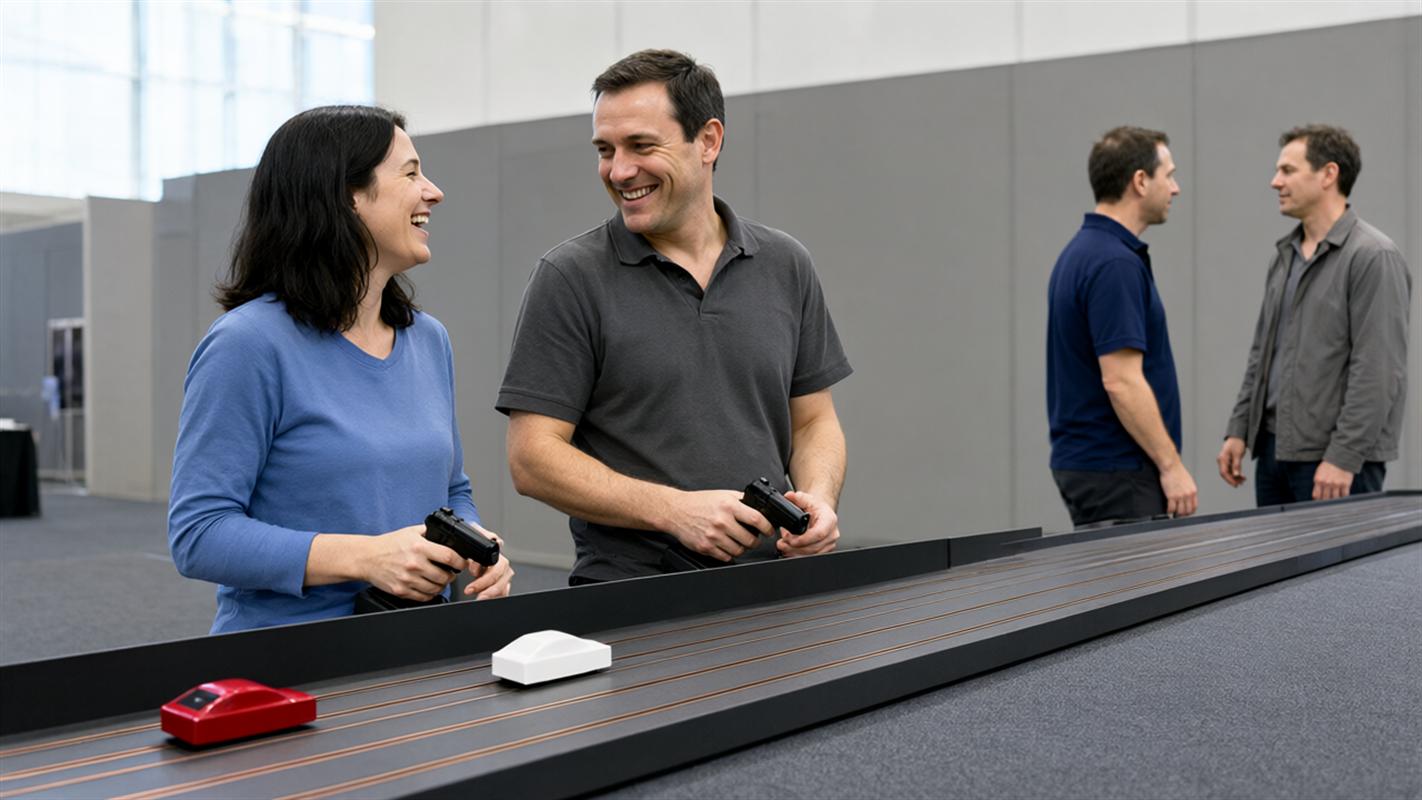
A shared activity handles that better than another screen. Racing gives two members something to do together, which turns an awkward stop-and-chat into a few minutes of competition and an easy opening for whoever is staffing the booth. The question worth settling before the track is ordered is what makes a trade show attraction worth stopping for, and at a member event the answer is usually participation rather than spectacle.
Reading the Conference Schedule Before Booking Anything
Association conferences run on blocks. Education sessions fill the morning, the hall opens in defined windows, and the breaks send several hundred people into the aisles at once. Traffic arrives in surges rather than a steady trickle, so a format built for short heats suits the room better than a long demonstration that holds the same four people for twenty minutes.
Ask the show for hall hours, break times, and move-in windows before choosing a footprint. Heat length is the number that decides throughput: a one- to two-minute race lets a queue turn over inside a single break and still leaves room for the conversation that follows it. A setup scaled for groups of 20 to 500-plus can be matched to whichever window it has to fill.
Planning an Association Exhibitor Booth Activation Around the Hall Itself
The venue contract usually decides more than the floor plan does. Aisle clearance, carpet and padding rules, noise limits near education rooms, labor and move-in windows, and the location of power drops all shape what can be built. An association exhibitor booth activation that skips those clauses tends to lose a morning to a facilities conversation, and the schedule rarely has a morning to spare.
Walk the space with the contract in hand before the layout is drawn. Battery power or a standard wall outlet keeps the plan flexible, and a track that runs indoors or outdoors covers the hall, the pre-function atrium, and the outdoor reception that often closes the day. Where the association sells sponsorship tiers, confirm early which sponsor marks belong on the activation and which belong on the booth graphics, so the two do not compete for the same surface.
Where the Race Sits in a Member-Facing Conversation
The order that works is attraction first, brief second, conversation third. Someone sees movement two aisles away, stops to watch, takes a controller, and only then becomes a person who can be asked about renewal, a committee opening, or the product on the counter. Racing supplies the first step; it does not replace the other two.
Professional Race Directors handle delivery, setup, operation, and breakdown, which keeps booth staff free to talk with the members who stop. That division of labor matters most in the busy window after a keynote, when the same three people are trying to greet, run a race, and answer a question at once. Keep the handoff short and agree in advance on the sentence that moves a racer into a conversation.
Fitting the Track to the Booth Contract
Layout follows the space, not the other way around. Track sizes start at 8 by 8 feet and extend to custom designs built for a particular hall, which is what makes a corner booth and an island equally workable. Multiple lanes keep a queue moving, and several tracks running at once let one booth serve two audiences in the same hour, whether that is a chapter group and a board member or two competing vendors.
Branding belongs on the surfaces members actually look at: cars, barriers, banners, and scoring displays. Race formats can run as a lap-time heat, qualifying into a final, or brackets with branded prizes, and the choice should follow the goal rather than the other way around. A short heat suits a hallway crowd, while a bracket gives a sponsor lounge a reason to fill across an afternoon; anyone weighing those formats can compare them on the page for portable slot car tracks built for trade show floors.
Staffing a Booth With Staff, Members, and Volunteers
Association booths rarely run on paid staff alone. The roster is usually a mix of association staff, volunteer leaders, and chapter representatives, and each brings a different conversation. Separate the three jobs before the hall opens: greeting and inviting, running the race, and talking with members. When the same person tries to do all three, the queue stalls and the conversation never starts.
Give volunteers a job that carries some status. Real-time scoring on a video monitor and a wireless microphone for the race caller turn a volunteer leader into part of the show instead of a person standing beside a table, and members who see a colleague announcing a race are more likely to walk over. Rotate the roles across the day so no one spends a full shift holding a controller.
What the Events Committee Will Ask Before Approval
Association bookings tend to pass through more hands than a corporate event does. The meeting planner owns the floor plan, an exhibit or sponsorship committee reviews what goes in the hall, and a board may see the budget line. That means the approval conversation is rarely about whether racing looks fun. It is about whether the activation fits the association’s own rules and whether it earns its place against the other things the same money could buy.
Come to that conversation with the practical answers ready. Expect a request for a certificate of insurance, a description of who operates the equipment and who supervises the booth, a footprint that matches the space already sold, and a short note on how the activation serves members rather than only the exhibitor. Where sponsorship tiers are part of the package, be clear about which marks the sponsor has paid for. A planner who can forward one clean summary to the committee is spared a round of follow-up email, and that summary is often what moves a maybe toward a signature.
What to Measure When Members Stop By
Association goals are rarely all lead capture. A conference booth may be there to support renewals, recruit committee volunteers, deliver a sponsorship commitment, or welcome first-time attendees who are deciding whether the association is worth joining. Measure against the goal the booth was approved for, and say so when the numbers are reported back to the events committee.
Count conversations by type rather than as one total, note which members race twice, and record which sessions visitors came from, since that last detail shows where the hall traffic actually originates. Ask the show for the scan data it collects so the booth count can be reconciled with the official attendance figure, and keep a short note on the questions members asked. Those notes are what turn a one-off booking into a plan for next year’s conference.
Proof From the Association Floor
At the ASAE 2026 conference, GrowthZone used a mobile slot car track from Nomad Raceways in booth 516, running beside demonstrations of its association management software, with the day’s best lap time earning a chance at a medal. The track gave association professionals a reason to stay in the booth long enough to hear about the software, and the mobile slot car track GrowthZone ran at ASAE 2026 is documented in its own write-up.
Kaspersky Labs ran racing with Nomad Raceways across three seasons and more than two dozen events, including Solutions Exchanges in the United States, Canada, and internationally. MC2 needed a custom track scaled to its booth space under a tight timetable for a three-day run, which is where layout flexibility earns its place in the plan. Those examples, and how each exhibitor measured the traffic, are collected in a trade show attraction case study that reports the booth results.
Key Takeaways
Five rules carry most of the planning for an association conference booth:
- Read the conference schedule first, because association traffic arrives in blocks around sessions and breaks.
- Walk the venue contract before the layout is drawn, and settle aisle, power, noise, and labor questions early.
- Keep the race short and the handoff quick, so the attraction leads into a conversation instead of replacing it.
- Give staff, volunteer leaders, and chapter representatives separate jobs, and rotate them across the day.
- Measure against the reason the committee approved the booth, and report conversation types rather than one traffic total.
Bringing the Idea to the Next Conference
The order to plan in is hall rules, then schedule, then footprint, then staffing, and finally the race format. Working in that sequence keeps the activation inside the venue’s rules and inside the association’s agenda, which is where most of the risk sits. Nomad Raceways works locally and worldwide, so the same planning steps apply whether the conference is across town or in another country. For dates and availability, it is worth requesting a quote for the conference dates once the hall details are in hand.