The booth is packed, the track is folded, and the badge scanner has handed over a file of names. That file is the easiest asset to collect at a trade show and the easiest one to waste. Leads rarely go cold because nobody was interested; they go cold because the record of the conversation never reached the person who could act on it. What follows is the work that starts when the hall lights go down. Nomad Raceways builds and runs portable slot car tracks at trade shows, corporate events and brand activations, and the follow-up questions that come back from those booths have a familiar shape.
Why a Booth Conversation Is Not Yet a Lead
A badge scan records that a person walked past a reader. It says nothing about which product they compared, whether they carry a budget, or whether they came to talk or to win a prize. A conversation is a different asset: it happened between two people, it carried context, and it exists nowhere except in the memory of the staff member who had it. A follow-up workflow exists to move that context out of one head before it fades.
The test for a usable lead is simple: could a colleague who was not at the show send the first message without asking anyone a question? If not, the record is a name, and the name will sit in a spreadsheet until it goes stale. The fix is not a better system. It is the habit of writing the note while the visitor is still at the booth.
What to Capture While the Race Is Still Running
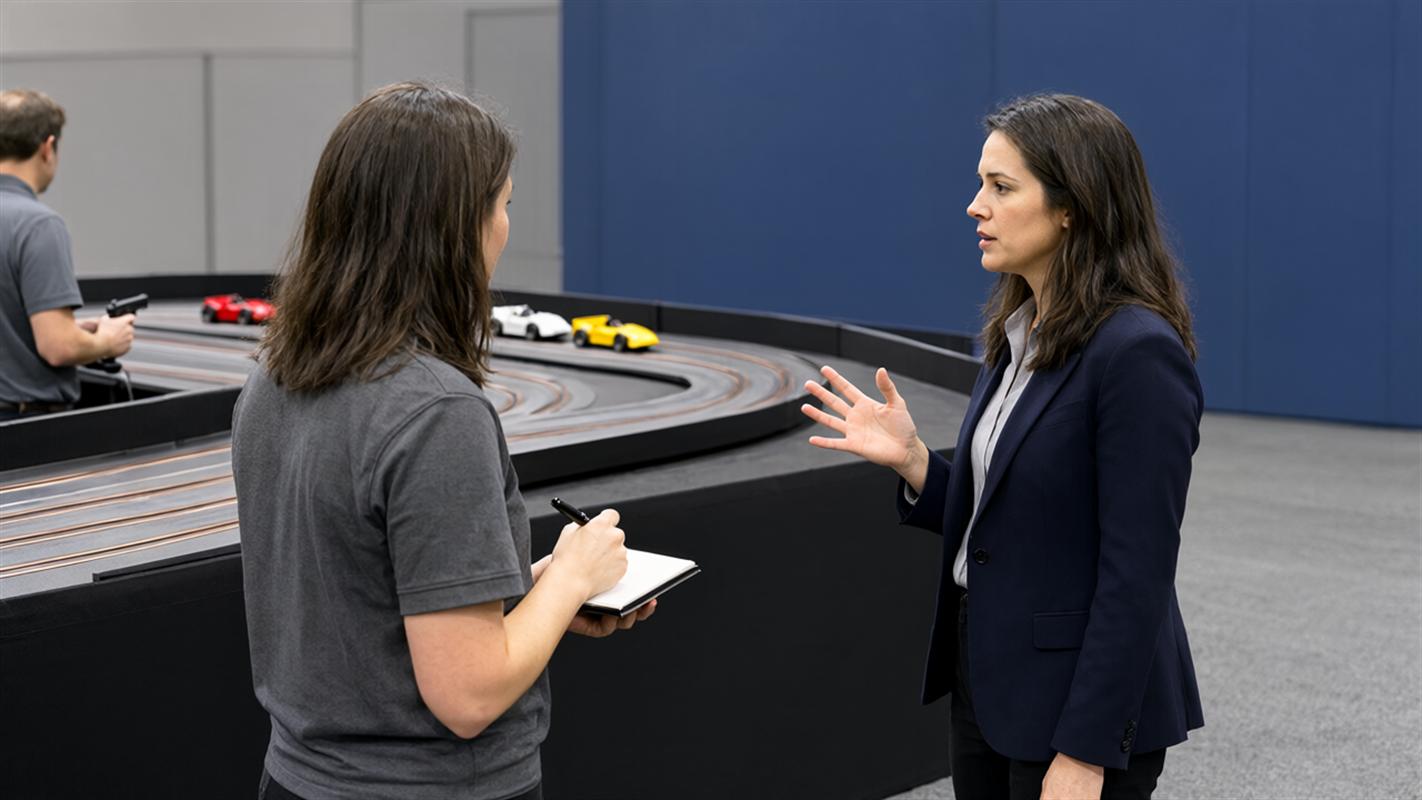
An interactive attraction buys a few minutes of attention most booths never get. A heat on a slot car track lasts one to two minutes, and a line forms behind it, which is exactly where the useful conversation happens. The person waiting is watching, relaxed, and usually happy to explain why they stopped.
Skip the transcript and capture four things: the race format the visitor ran, the result that appeared on the board, who they raced if they arrived with a colleague, and the words they used for the problem they are trying to solve. A short note on each takes under a minute and gives the follow-up an opening line specific to that person rather than to the booth.
The layout decides where the capture point goes. Tracks start at eight by eight feet and can be built to a custom layout for the space, and a setup can run indoors or outdoors on battery power or a standard outlet, so the station should sit wherever the line forms rather than wherever the table happens to be. Group sizes run from 20 to more than 500 and setup takes anywhere from under an hour to two days, which is also a fair guide to capacity: a booth serving hundreds with one tablet creates a line nobody wants to join.
Building a Trade Show Lead Follow-Up Sequence for the First Week
Sort before writing anything. Three buckets cover most of a show list: visitors who described a problem with a timeline, visitors who were interested but had no date attached, and visitors who came for the race and left nothing behind. The three need different messages at different speeds, and treating them as one list is how the good ones get buried.
The first week of a trade show lead follow-up sequence has a shape worth keeping. Day one, a short note that names the race and asks the one question the conversation left open. Day three to five, a second touch that adds something of use: a spec, a comparison, or a time for a call. Day seven to ten, a third note with a single question and an easy exit. After that the lead belongs in a longer cycle.
Formats give the sequence its vocabulary. A lap-time heat, qualifying into a final, or bracket play with branded prizes produces a moment each visitor remembers differently, and that difference is what keeps a message from reading as a template. A visitor who reached a final has a story to be reminded of; one who went out in the first heat has a joke.
Who Owns Post-Show Lead Management
One name, decided before the show opens. Post-show lead management fails most often at the seam between the team that ran the booth and the team that sells, and on a booth with an attraction that seam is wider because the attraction is often run by a separate crew. The record needs an owner, a home and a definition of done, settled while the show is still a calendar entry.
The split is easy to state on a racing activation. The Race Directors handle delivery, setup, operation and breakdown, and their work ends when the track is packed. The contact record belongs to the exhibitor, notes included, and the handoff should be a file with a time on it rather than a folder of photographed business cards.
The staffing plan is where that handoff gets real. The interactive attraction staffing model for trade show booths works through the split between greeting, operating, managing the line and holding the conversation, and the person holding the conversation is the one whose notes the follow-up depends on.
Writing a Message That Recalls the Race, Not the Booth
Open with the race. Most booth follow-ups fail in their first sentence by talking about the company instead of the visitor’s afternoon. The scoring detail helps: wireless microphones and video monitors show real-time scoring, so the lap time or bracket position quoted back is a fact the visitor watched appear, not a sales device.
Keep the note to four sentences. One line that places the race, one observation that shows someone was listening, one useful item, and one question with a clear next step. A spec sheet, a comparison or an invitation to a call qualifies as useful. A paragraph about brand values does not.
Replies need somewhere to go. A “not now” is a record too, so note the date the visitor named and return the lead to the calendar for it. A question moves to whoever can answer it within the day.
Where Follow-Up Slips
Four failures account for most of the leads lost after an otherwise strong activation, and each is easier to fix before the first message goes out.
- Notes taken from memory days after the hall closed, when the details that made the conversation worth continuing have gone.
- No named owner for the list, so the first message waits on a decision about who should send it.
- A generic message that could have gone to every badge scanned at the show, which the visitor recognizes immediately.
- A sequence that stops after one attempt, when the reply that mattered was going to arrive at the second or third touch.
An attraction produces a stronger first conversation and a weaker paper trail than a static booth. Racing is memorable and busy, and busy is where notes get skipped. The approach set out in turning booth traffic into qualified leads covers the capture side; these four are what happens when capture is not carried into the week after.
Using the Activation in the Second and Third Touch
The attraction keeps working after the show when it is used as material rather than as a memory. Cars, barriers, banners and scoring displays can carry exhibitor branding, so a photo from the booth is still on-brand in a follow-up email, and a branded prize is a reason to write a second time without inventing one.
Repeat bookings tell the same story from the exhibitor’s side. GrowthZone ran racing beside its software demos at ASAE 2026, with a medal for the day’s winning lap time, and Kaspersky Labs has run the attraction across three seasons and more than 24 events. Neither result came from the track alone; both came from a booth plan that knew what happened after the race ended. The trade show attraction case study sets out how those booths handled the handoff from race to conversation, and the trade show slot car track rental service page covers formats, footprint and branding.
What to Review After the First Week
Read the replies before reading the numbers. Group them by the bucket the lead came from, and look for the bucket that answered and the one that went quiet, since the quiet one is usually where the first message was written without a note to work from. Then check which touch produced the reply.
Two questions close the review: did the record contain enough for the message, and did the sequence run on the dates it was supposed to? A sequence that produced replies but ran a week late has a different problem from one that ran on time and produced nothing.
Key Takeaways
- Write the note at the booth, while the visitor is still in earshot, because the context is the asset and the scan is not.
- Capture the race format, the result, the companion and the visitor’s own words for the problem.
- Name one owner for the list before the show, and hand the file over with a time on it.
- Run the first week as three dated touches rather than a single message.
- Review replies by source bucket and by which touch produced them, then correct the bucket that went quiet.
None of this requires a bigger booth or a longer show. It requires the follow-up to be designed at the same time as the attraction, with the capture point, the owner and the first message settled before anyone arrives.
Making the Follow-Up Part of the Show Plan
The exhibitors who get value from a booth activity usually decided, before the show, who would write the notes, where the file would land, and what the first message would say. That planning takes an hour and saves the week after. Nomad Raceways travels locally or worldwide, so the same process can be repeated in another city without rebuilding it.
For teams planning the next activation, requesting a quote is the point where footprint, formats, branding and race management get matched to the venue, and where the handoff plan can be written into the booking rather than improvised on the last day.
⚠️ File-mutation verifier: 1 file edit(s) FAILED this turn despite any wording above that may suggest otherwise. Run `git status` or `read_file` to confirm what actually landed.
• `/home/richard/.hermes/cache/scratch/lift_payload.py` — [write_file] Refusing to overwrite `/home/richard/.hermes/cache/scratch/lift_payload.py`: `/home/richard/.hermes/cache/scratch/lift_payload.py` exists but this task has not seen its full current c…