Two quotes can describe the same track and still cover very different amounts of work. One supplies equipment and a number to call with questions. The other supplies a crew that owns the attraction from load-in to load-out. That difference is what a professional slot car track operation means in practice, and it is worth settling long before a booth deposit goes in.
The track is the visible part. The operation is what decides whether a four-day show still runs cleanly on the last afternoon, when the crowd thins, the carpet is worn, and one car has stopped responding. Nomad Raceways builds and runs portable slot car tracks for trade shows and corporate events from its base in Vista, California, and travels to venues locally and worldwide. The service layer is the piece that is hardest to compare from a website. Trade show racing activations photograph well; the operation is what your booth team actually lives with across the run of a show. What follows is the service layer itself: setup before the doors open, the Race Director’s work during a session, and the support that keeps the attraction running for the length of a show.
Where Rental Ends and Operated Service Begins
Rental is a handover of equipment. Operated service is a handover of responsibility. In the first arrangement, the cases arrive, someone on the booth team reads the setup notes, and the attraction performs as well as the spare attention you can give it. In the second, the supplier’s crew owns delivery, assembly, racing, and the load-out at the end of the show, while the exhibitor’s team stays on the stand doing the work only they can do.
An operated layer tends to include the same set of pieces, whatever the venue:
- Delivery and venue access, including the move-in window and dock arrangements
- Assembly, layout confirmed against the actual floor, and test heats before the hall opens
- A crew on site for every show day, not just the first morning
- Race formats, timing, and scoring, called and managed during the session
- Branding applied to the track, the barriers, and the cars
- Breakdown, packing, and load-out once the doors close
The crew that arrives is usually the crew that runs the racing. At Nomad Raceways, Race Directors handle delivery, setup, operation, and breakdown, which means the person who placed the track is also the person calling the first heat.
Setup: What Happens Before the Doors Open
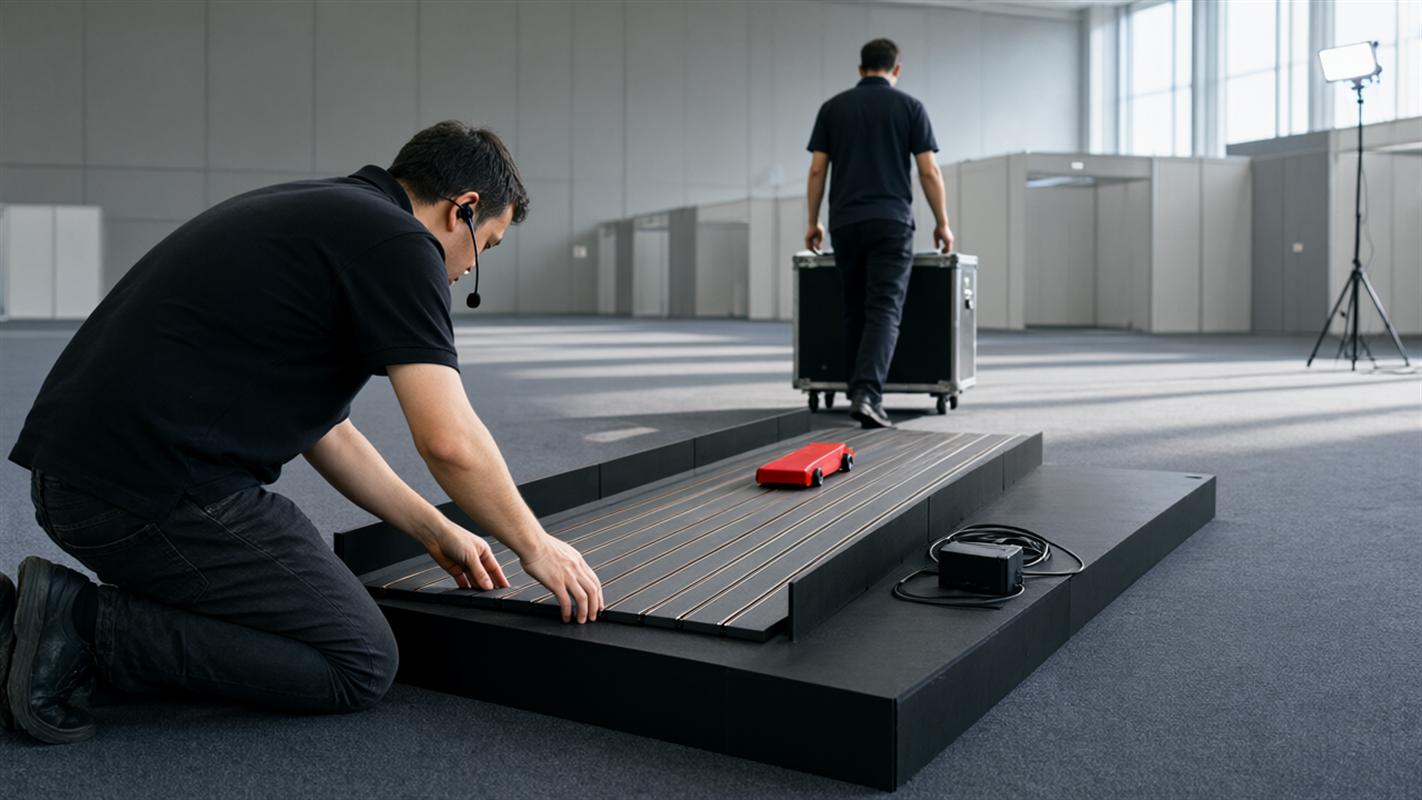
Setup starts with the venue calendar, not the track. Delivery has to land inside the move-in window, and the floor has to be walked before the layout is fixed, because the footprint marked on a booth plan and the usable space beside a neighboring island are rarely the same. Power comes next. Tracks run indoors or outdoors, on battery power or a standard outlet, and that question is settled before the cases are opened rather than after.
Once the track is down, the crew runs test heats. Cars, controllers, lane changes, timing, and the display all get exercised in the order a visitor will use them, and a handover check confirms the attraction is ready for the doors rather than ready for the crew. Setup time runs from about an hour to two days depending on the track and the venue, so the move-in slot matters as much as the equipment list.
The planning detail behind those steps sits in the setup checklist for interactive trade show attractions, which covers space, power, visitor flow, branding, and staffing from the exhibitor’s side. What an operated service adds is that the crew doing the work has assembled that same track before.
What the Race Director Manages During a Session
The Race Director is the person who paces the attraction. That means calling the races, holding the format, keeping the queue moving, restarting a car that has come off the lane, and deciding when to rotate a group that has been standing in the same spot too long. Little of it reads as skilled work from the aisle. All of it is the difference between a line that moves and a knot of people blocking the neighboring booth.
Two operational details carry most of that pacing. Heats typically last one to two minutes, and several tracks can run at once, so a group rotates through rather than waiting out a long race. A wireless microphone and video monitors showing live timing and results keep the crowd watching the racing instead of watching the clock.
Staffing the booth side of the attraction is a separate planning job, covered in this interactive attraction staffing model for roles, flow, and day-of coverage. This section stays on what the operator supplies; that one covers how a booth team is built around it.
Race Formats That Come With the Operation
Formats are part of the service, not a menu item added at the end. A lap-time heat suits a busy floor where visitors want one quick run. A qualifying round that feeds a final suits a booth running a competition across the day. Knockout brackets suit a group that wants a storyline, and branded prizes give the winner something to carry back to the aisle.
The format follows the crowd. A short heat keeps a queue manageable at a show where visitors are already moving; a bracket gives a smaller group a reason to return for the next round. Heat length stays deliberately short so you can move a fixed number of people through in an hour without the crew rushing the racing itself.
Event Support on the Show Floor
Support is the part of the service that gets tested on day two. A crew is on site through the show day, with spare cars and controllers close at hand so a failure becomes a swap rather than a stoppage. When the queue changes shape, the crew adjusts with it: a longer rotation during a quiet hour, a tighter one when the aisle fills.
The crew also handles the venue side. Show services, power questions, and access constraints are the operator’s conversation to have, which leaves the booth team in conversations with visitors rather than on the phone to the facility. Breakdown follows the same pattern at the end, with the space returned to the condition it was found in and the equipment packed for the next stop.
Scale is what the support gets sized against. Tracks run from a compact 5 by 10 foot layout that carries four racers at a time to a 15 by 22 foot centerpiece, and group sizes run from 20 to more than 500 people. Those numbers decide how many crew, how many cars, and how many lanes an event actually needs.
Branding and Custom Work Inside the Service
Branding that belongs to the operation is applied to surfaces the racing already uses: the cars, the track barriers, the banners, and the scoring displays. Placement matters more than the artwork, because a mark on a car is seen by the person holding the controller while a mark on a barrier is seen by everyone waiting behind them.
When a standard layout will not fit the space or the moment, a custom slot car track design is built to the footprint instead of the other way around. Reach belongs in the same conversation. Some tracks travel by truck, while a smaller track can ship as checked airline baggage, so a venue well outside California does not close the door on its own.
What Stays With the Exhibitor
The boundary is worth stating plainly, because it is where expectations drift. Booth messaging, lead capture, the conversations that follow a race, and staffing the stand itself stay with the exhibitor’s team. The operator runs the attraction; the exhibitor runs the reason the attraction exists.
That split shapes the quote as well. An offer that assumes the booth team supplies tables, storage, and a power drop is a different offer from one that arrives with those questions already answered, and the difference only surfaces when the two are placed side by side. Knowing which side owns which item is what makes a comparison useful.
What the Event Activation Service Scope Should Spell Out
A written scope turns a conversation into an agreement. It should name the track and its footprint, the power source, the crew size, the race formats, the branding elements, the setup and breakdown windows, and who supplies tables or storage on site. Each line answers a question your team would otherwise ask at seven in the morning on move-in day.
Ask what the event activation service scope includes before comparing two quotes, because a quote built on a narrower scope is not the same job described more tightly. It is a different job, with part of the work shifted back onto the booth team. The same track can appear in both quotes while the labor around it differs entirely.
With the dates, the venue, and the booth dimensions in hand, the next step is to request a quote for the event and read the scope line by line rather than the headline.
Key Takeaways
- An operated service hands over the run of the attraction, not just the equipment.
- Setup is confirmed against the actual floor, the available power, and a set of test heats before the hall opens.
- Race Directors pace the attraction, call the format, and keep a queue moving through one- to two-minute heats.
- Branding, custom layouts, and travel arrangements belong to the service layer and are decided before the event, not on site.
- A written scope names the track, footprint, crew, formats, and setup windows so each side knows what it owns.
Conclusion
The attraction is what a visitor remembers. The operation is what holds up when the show runs to four days, the aisle stays busy, and the tenth group of the afternoon expects a race as good as the first one. Setup, the Race Director’s work on the floor, and the support behind both are the parts of a slot car booking that a photograph never shows.
Nomad Raceways supplies that layer as a track rental and event activation company, with portable tracks, branded cars, and Race Directors who handle the day from move-in to load-out. For an exhibitor weighing an interactive attraction against a quieter booth, the useful question is not only what the track looks like, but who will be standing beside it at nine in the morning.