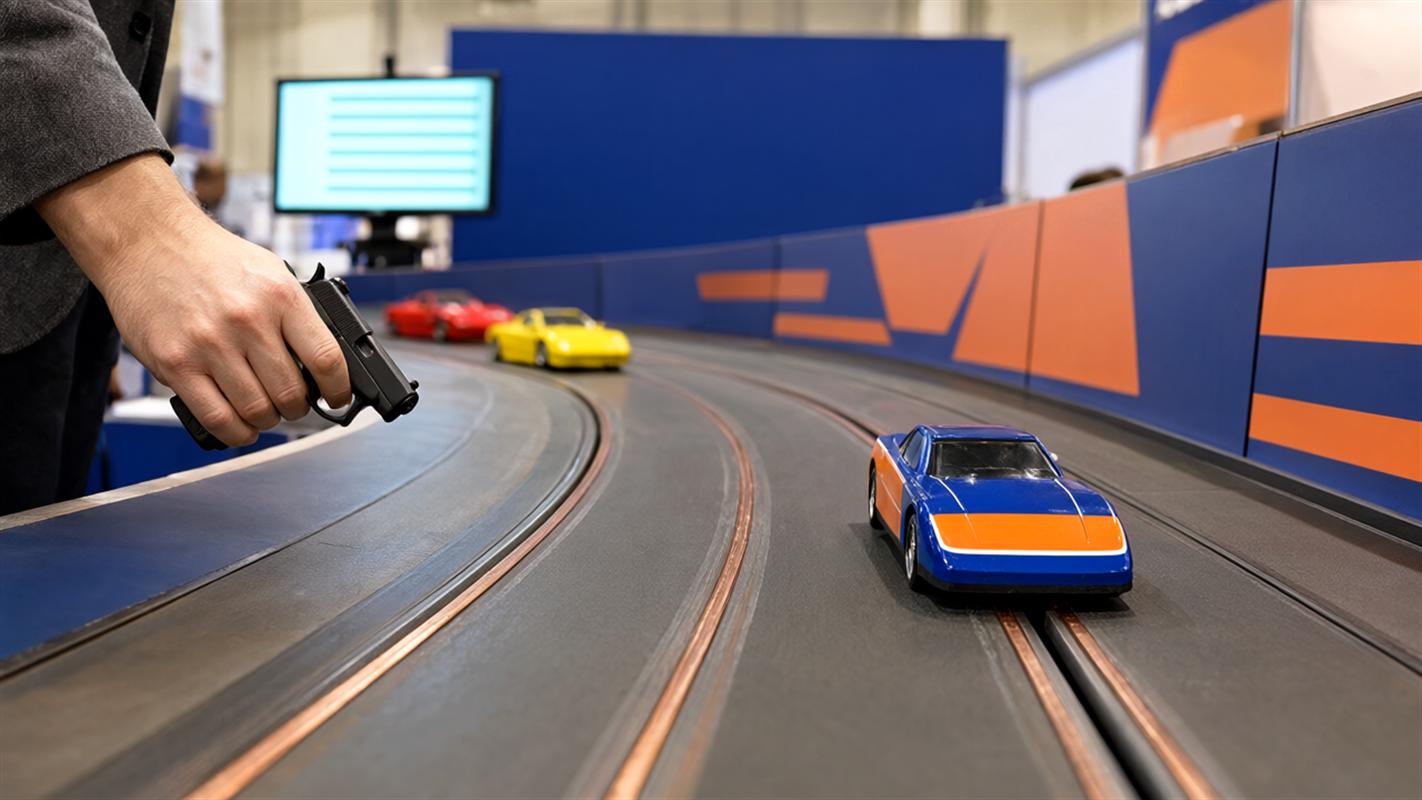
Four surfaces on a racing attraction carry a brand, and they do not carry it equally. The cars sit in a driver’s hands. The track and its barriers face the aisle. The scoreboard and monitors hold the room’s attention between heats. Sponsor marks sit on top of all three, sometimes comfortably and sometimes not. Reading those surfaces as interchangeable, one logo file applied everywhere, is the most common reason a branded activation looks like decoration rather than marketing. What follows is a walk through each option, what it is good at, and the order in which the decisions are worth making.
Why Branding Choices on a Race Attraction Are Not Interchangeable
A race attraction puts a brand in front of three audiences at three distances. The person holding a controller sees the car at arm’s length. A visitor waiting for the next heat sees the barrier and the start line. Someone walking past the aisle sees only the silhouette of the track, the glow of a screen, and whatever text is large enough to read while moving. A design decision that works for one of those viewers usually does nothing for the next.
The layout question therefore comes before the artwork question. Rentals are built to work in a small trade show booth, a ballroom or an outdoor lot, and the same set of surfaces reads very differently in each. Tracks run on battery power or a standard wall outlet, indoors or outside, so the siting is a real choice rather than something the venue decides. The purpose behind the activation shapes the rest: a booth trying to stop traffic and a hospitality space trying to thank partners need different surfaces doing the work, and how a racing rental supports brand experiences covers that layer in more depth.
What Custom Branded Race Cars Change About the Race
The car is the most personal surface in the setup and the smallest. Logos and colors on the body are seen by one driver at a time, often while the car is being set into its lane, which makes a car a recall mechanism rather than a reach mechanism. Nobody across the aisle reads a livery. The driver remembers it.
What a car can do that a banner cannot is get spoken. Cars can be named after product lines or features, and a Race Director calling a heat turns those names into vocabulary the crowd hears repeatedly without a single claim being made about the product. Extra cars can also leave the booth as gifts, which extends the surface well past the event. The trade-off is arithmetic: a car holds very little text before the design stops reading, so a mark and a color usually do more work than a message.
Track Graphics and Barrier Branding: The Largest Surface You Own
Barriers, start-line signage and track-side panels are what the aisle reads, and they are read from roughly ten to thirty feet away by someone who is still walking. That distance sets the design: fewer words, larger shapes, higher contrast, and a tolerance for being seen at an angle rather than straight on.
This layer is also where banners and track elements carry the exhibitor’s messaging with colors matched to the brand, which makes it the least expensive place to establish identity across a wide area. The failure mode is density. A barrier covered in paragraphs looks busy from six feet and looks like texture from twenty, so the strong version of this surface is usually one phrase repeated at scale rather than a full message stated once.
Scoreboards, Monitors, and Announcer Scripts as Branding Space
Screens are the only surface that repeats. A heat lasts a minute or two, the standings change, and every change pulls eyes back to the display. A branded frame around the scoring display, or a sponsor rotation between heats, collects that attention several times per group instead of once per visitor.
Video monitors showing close-up action can also feed a venue’s larger screens or multiple displays, which puts the brand in front of people who never came near the booth. Wireless microphones do the audio version of the same job. The discipline here is restraint. A screen that shows nothing but logos loses the reason people looked at it, so branding works when it frames the timing and the race rather than replacing it, and an announcer who names a heat sponsor once per race carries further than a script that mentions four sponsors in every sentence.
Where Sponsor Integration Fits, and Where It Fights
Sponsor marks belong where a partner can be named out loud and seen at the same time. Car livery suits a title partner who wants the closest association with the racing. Barriers and track-side panels suit supporting sponsors who need presence across the whole footprint. A scoreboard frame suits the partner tied to results or a timed challenge, and the podium suits the one supplying prizes.
The conflict is almost always visual rather than contractual. An exhibitor’s mark and a sponsor’s mark competing for the same small surface make both harder to read, and a car carrying four tiers of logos reads as none of them. Tiering is the fix: one surface per tier, one dominant mark per surface, and an early decision about how many partners the livery can hold before it stops working. Fewer sponsor logos at a larger size is nearly always the better trade.
Putting the Options in Order
The sequence that avoids rework starts with the build, not the artwork. Space and format come first: tracks start around 8×8 feet and scale up, setup can run from about an hour to two days depending on the build, and groups from 20 to 500-plus change how many lanes and tracks run at once. Settling the footprint of the branded slot car track before any file is approved saves the entire graphics layer from being designed twice.
Barriers and track graphics come next, because they depend on the layout. Cars follow, since livery is drawn against colors and sightlines that now exist. Sponsor tiers come after that, because they are created by dividing surfaces already in place, and prizes close the sequence. Race formats decide what a prize is for, whether that means lap-time heats, qualifying into a final, or a bracket, and branded prizes put a name on something that leaves the building. Each step is cheaper to change at its own point in the order than it is later, and when a booth footprint forces a nonstandard layout, custom slot car track design for a specific booth footprint sets out where a build stops being an upgrade and starts being a requirement.
What Branding Cannot Fix
Branding does not create throughput, queue space or a sightline. If the attraction does not fit the footprint, or the crew cannot rotate players fast enough to keep the line moving, better graphics make a crowded booth look more crowded. Guests read a stalled queue as a problem with the brand long before they read the barrier.
That boundary is worth stating plainly during planning. The setup works when the space, the power source, the Race Director and the exit route are settled, and the branding layer sits on top of a functioning activation rather than compensating for an unfitted one. A graphics review that happens before the layout review tends to produce expensive decisions that get reversed on site.
Practical Logistics That Shape the Branding Layer
Two logistics decide how much of the plan survives contact with the venue: who approves artwork, and how far ahead of time. Printed surfaces need production time, and custom branded race cars need the longest runway of all, because the surface is small, curved, and hard to correct once printed. Screens are the opposite, since content can change the week of the show, which is why a late sponsor addition is usually a screen decision rather than a livery decision.
Siting matters as much as approval. An outdoor lot in daylight flattens contrast that reads well under booth lighting, and wind and weather put limits on what can be hung. Delivery and setup are handled by the operating team, with Race Directors on site to assemble, run and break down the equipment, and mobile slot car track hire covers what that visit includes. Nomad Raceways works locally or worldwide, and the branding conversation gets easier once the venue, the dates and the available power are known.
Key Takeaways
Branding a race attraction is a set of decisions about where a mark is seen, by whom, and how often, and the answers differ by surface.
- Settle the space and the build before approving any artwork, because the graphics layer depends on the layout.
- Design barriers and track graphics for reading at a distance and in motion, with one phrase at scale rather than a paragraph.
- Use car livery for recall with the driver, and let announced car names carry product vocabulary.
- Give each sponsor tier its own surface, with one dominant mark per surface, to keep any partner from diluting another.
- Build the screen layer last, since monitors and scoring displays can change close to the event and earn repeated views.
Conclusion
Arriving at the first conversation with booth dimensions, the surfaces in play, the sponsor tiers, the event dates and the available power shortens the path from a good idea to a build that fits the room. Corporate event entertainment shows how the same attraction works outside a trade show floor, and requesting a quote starts the discussion with the details that shape a design.