
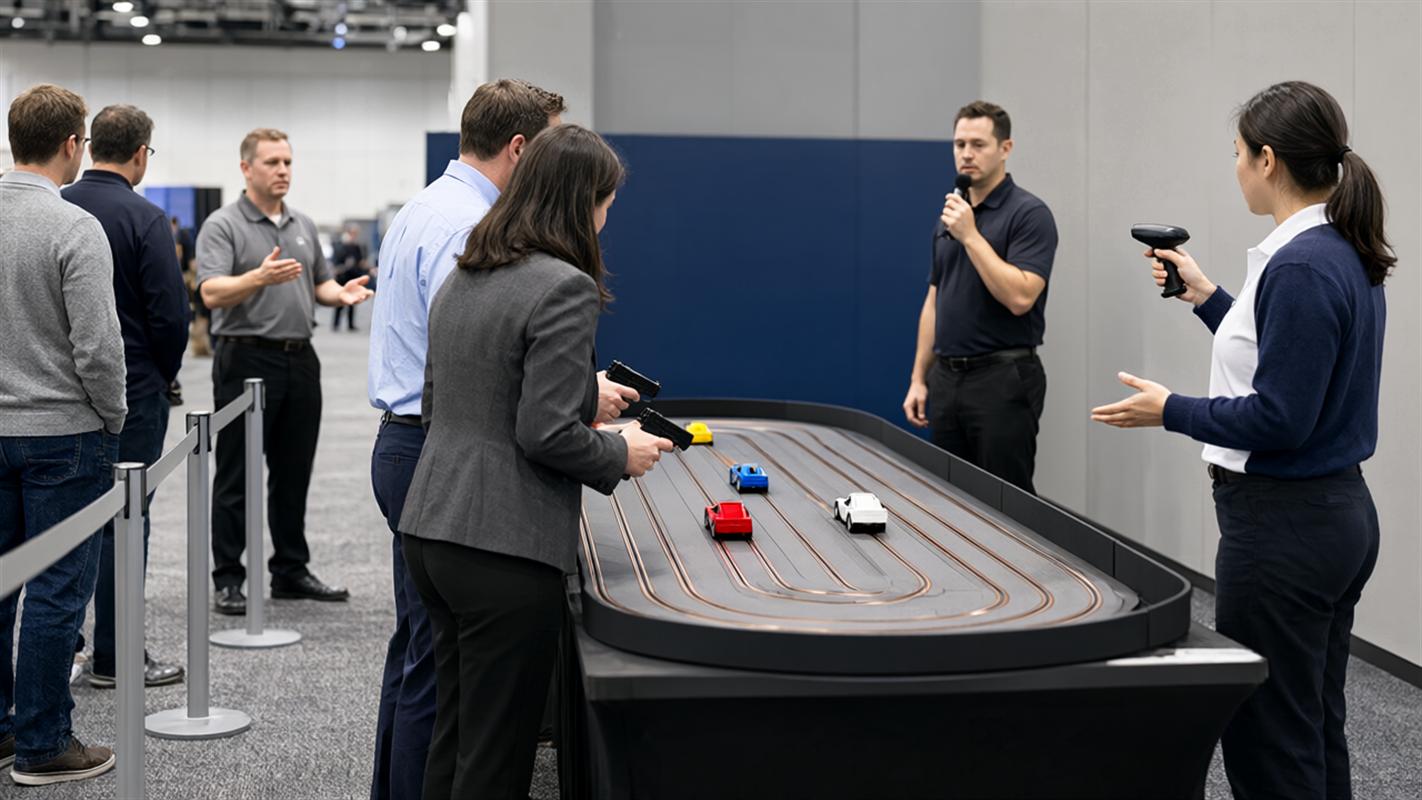
A crowd at the end of the aisle does not staff itself. An attraction that pulls people off the show floor creates four jobs at the same moment: inviting people in, running the race, holding the line, and turning the stop into a conversation worth following up. Most booth teams plan for one of them and meet the other three in the first busy hour. The track is the straightforward part. Trade show booth staffing is where a good attraction either keeps moving or turns into a crowd with nobody in charge. What follows is a working model for the roles, the places they hand off, and the coverage a full show day actually needs.
What the Staffing Model Has to Cover
Four jobs run at once, and each one keeps a different clock. The race director works in heats of one to two minutes, so the format decides what happens the moment a heat ends. The line host works in a continuous loop, because a line does not pause when a race does. The booth host works in conversations that begin halfway through, with someone who has just watched a race and is deciding whether to stay. The person on lead capture works in short windows, because a note taken while the race is still on the screen carries more of the conversation than one written an hour later.
The mistake is assuming one person can hold all four. At low traffic, one person often can, and that is fine. At peak, the job that gets dropped is predictable: the record. The race still runs, the line still gets managed, the conversation still happens, and nobody writes down who was standing there. Splitting the roles is less about adding bodies than about deciding in advance which job each person is not doing.
The Roles in an Interactive Attraction Staffing Plan
Interactive attraction staffing holds together when every role is named before the floor opens, because a role without a name becomes whoever is closest to the problem. Four roles cover most show floors.
- Race director. Supplied by the attraction operator, this is the person who delivers the track, builds the layout, runs the heats, calls the race over the wireless microphone, keeps the scoring display honest, and breaks the equipment down at the end. They are the only person on the booth who should be touching the cars mid-show.
- Line host. Owns the wait. Decides where the line forms, how far it is allowed to grow toward the aisle, and what every waiting person is told: what the race is, roughly how long the wait is, and whether they can watch a heat first before driving one.
- Booth host. The exhibitor’s voice at the edge of the attraction. Greets the spectators who are not racing yet, connects what just happened on the track to what the company does, and works out who is worth a longer conversation.
- Lead capture. Holds the badge scanner or the list and catches the stop while it is fresh, with a line beside the name about what the person raced, asked, or reacted to.
At a quiet show, the booth host can absorb the line host’s job without much cost. The two roles that should not be merged are the race director and the record. One keeps the attraction running; the other is the only thing the booth takes home.
Where the Race Director’s Job Stops and the Booth Team’s Begins
The race director owns the equipment and the race itself: delivery, setup, power, heats, scoring, breakdown. That scope is wide enough to fill a day, and it is worth saying plainly that the race director is not a salesperson and should not be asked to qualify attendees. A person holding a controller and a person explaining a product are having two different conversations, and asking one of them to do both produces a race that stalls and a pitch that starts cold.
The exhibitor’s team owns the message, the qualification and the follow-up. What passes between the two sides is short and specific: the race director knows who is in the current heat, who has been waiting longest, and what the format does next. The booth team knows why any of it matters to that particular attendee. Whoever is capturing leads needs to stand close enough to hear the race director’s call, because that call is usually where the opening line of a conversation worth having comes from.
Managing the Line Without Blocking the Aisle
Three zones do most of the work: entry, wait and exit. Entry is where someone is invited in and briefed. Wait is where the line stands without crowding the track or the aisle. Exit is where a racer collects a prize, hears where to go next, or gets pulled into a conversation. The footprint of a racing attraction includes all three. A layout can start around 8×8 feet and grow into a custom build shaped to the booth, but the track measurement is the smallest number in the plan. Queue space belongs in the layout conversation alongside the track itself, and the wider question of booth footprint planning is covered in the trade show entertainment footprint guide.
Heats set the rhythm of everything downstream. At one to two minutes a heat, with several lanes running at once and sometimes more than one track in play, the line moves in bursts rather than steadily. The format also decides who comes back: a single timed lap keeps the queue moving through new faces, while a qualifying round into a final, or a bracket with branded prizes, pulls earlier racers back to the same spot later in the day. A line host who tells each group what is coming keeps the bursts orderly. A line host who lets the queue guess produces drifting, aisle blocking, and the slow erosion that ends with people walking away mid-wait.
Handoffs Between Shifts, Breaks, and the Midday Lull
A handoff is not a change of position. It is thirty seconds of specific information: who is in the heat right now, who is waiting, which conversations are warm, what the next round is, and where the prizes are. The test of a good handoff is simple. Whoever takes over should be able to answer the next attendee’s question without starting the sentence over.
Breaks need a named cover before the floor opens, not a hopeful glance around the booth at the moment someone needs to step away. The midday lull is the other half of the plan. It is the window for resetting the layout, checking that branding on the cars, barriers, banners and scoring display is still where it should be, testing the monitors, and briefing the next block of the team while nobody is waiting.
A Day-Of Coverage Schedule That Holds Up
Before the floor opens, the race director and the booth lead walk the whole setup together: track layout, power source, whether the setup is running from a standard outlet or battery, scoring display, microphones, and the branding sightlines from the aisle. That walkthrough is also where the roles are said out loud, so nobody learns their job from the first problem that arrives. The same walk is set out item by item in the trade show interactive attraction setup checklist, and it takes less time than the first hour of confusion costs.
The middle of the day is the straightforward part: all four roles staffed, and the record being written. Setup timing matters here too, since a layout can take anywhere from under an hour to two days depending on the build and the schedule, and a late build compresses the part of the day that cannot be compressed.
The last hour is where coverage quietly fails. Teams start packing, the floor thins out, and the attendees still walking are often the ones who spent the day in meetings. Keep the attraction live and the record open until the hall closes. Breakdown belongs to the race director, but the exhibitor’s team should have collected the leads and the branded material before the track comes down.
Common Staffing Failures on a Show Floor
Five failures repeat. The whole team turns to watch the race, so nobody is looking at the aisle the crowd came from. The line has no owner, so it grows until it blocks a neighboring booth. The booth host gets pulled into a heat, and the attendee who wanted to talk about the product spends the next race behind a controller instead. The shift change happens without a briefing, and the second half of the day starts from zero. Nobody is assigned to the last hour.
There is a sixth, and it is the expensive one. The badge gets scanned, the lead goes into the system with a name and an email, and nothing else. By the time the follow-up call happens, the only thing anyone remembers is that the person stopped at a booth. A single line about the race they ran is what turns a scan into a conversation a week later.
How Many People Do You Actually Need?
Start with roles rather than bodies: one person per active role at peak. Peak is set by three things, and none of them is the size of the booth. Heat length decides how fast the queue turns over. The number of lanes and tracks decides how many people are active at once. The number already waiting decides whether the line host is managing a queue or managing a crowd.
Group size moves the answer again, since the same setup can serve a group of about 20 or a floor of 500-plus across a day. Trade show booth staffing also depends on who supplies whom. The operating team brings the race director and the equipment; the exhibitor brings the booth host, the lead capture person and whoever covers the breaks. That split is settled while the event is being planned, not on the floor. The trade show attraction case study shows how the two sides meet over a full show.
Key Takeaways
- Name the four roles before the floor opens: race director, line host, booth host, lead capture.
- Keep the race director on the track and out of qualification conversations.
- Give the line its own owner and its own space, separate from the track.
- Brief every handoff with who is racing, who is waiting, and which conversations are warm.
- Stay staffed and keep the record open through the last hour of the show.
Conclusion
The booth works when the roles are named before the doors open. Nomad Raceways supplies the portable track, the race directors, the scoring and the branded cars, and the exhibitor’s team keeps the conversation. Custom track design and branded car customization let the attraction fit a specific booth and a specific message, indoors or outdoors, on battery or a standard outlet, locally or worldwide.
If the next show includes a racing attraction, the useful planning conversation is not how many people to bring. It is who is doing which job at eleven in the morning, and who is doing it at four. For a layout that fits the booth and a team that knows the plan, look at the trade show racing attractions and then request a quote for your show floor.