Most booth plans make the demo the main event and assume the crowd will follow. On a show floor, visitors arrive in a different order. Someone sees movement at the end of the aisle, walks over to find out what is happening, and only then becomes a person who can be shown a product. Building the booth around that order — attraction first, demonstration second, conversation third — is the difference between a demo that runs all day to empty floor space and one that runs to people who stopped on purpose.
Why a Trade Show Product Demo Needs a Reason to Stop
A trade show product demo is a reward for attention that has already been given. It works on the person standing in front of it: close enough to see the screen, willing to listen for a few minutes. What a demo rarely does is create that attention from a distance. A monitor looks like a monitor from the far end of the aisle, and a presenter speaking to two people reads as a closed conversation.
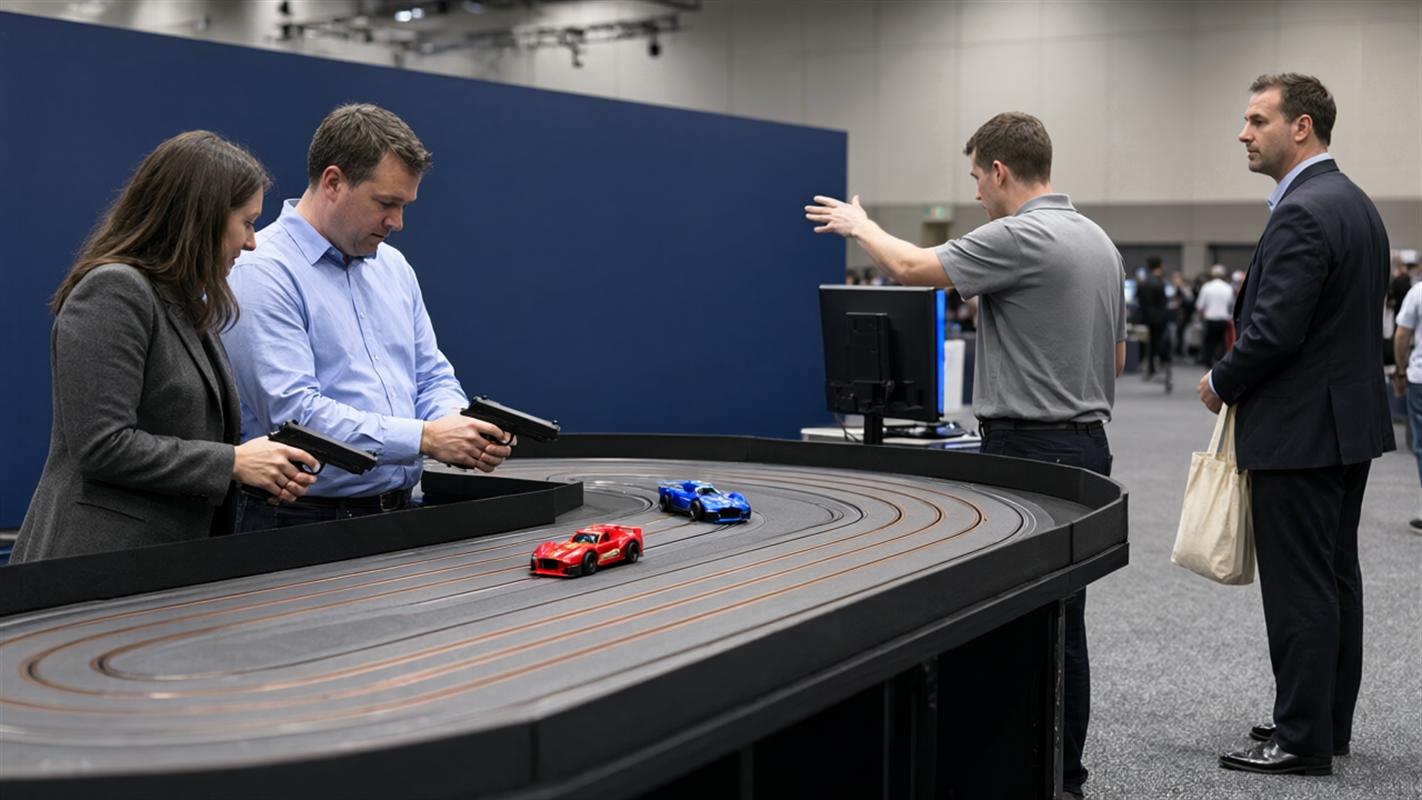
A race reads differently. Cars moving on a visible track, a scoreboard changing, a small crowd reacting to a close finish — that is legible before anyone knows what the booth sells. The attraction supplies the first stop, and the demo supplies the reason to still be standing there five minutes later. Neither piece carries the booth on its own.
What an Interactive Product Demo Attraction Adds
An interactive product demo attraction changes the visitor’s role. Watching a demonstration is passive; taking a one-minute heat is not. The visitor is doing something with their hands, inside your space, with a result attached to it. That shift matters for a practical reason: a participant stays in the booth long enough to be spoken to, and the booth team gets an opening that does not feel like a cold approach.
The activity also gives the team somewhere to stand. Instead of hovering at the edge of the aisle, staff have a reason to be near the track, comment on a lap, and begin the conversation that leads into the demo. The racing is not the message. It is the mechanism that puts a visitor in front of the message with their attention already turned on.
The Demo-to-Race Sequence, Step by Step
The working order is simpler than most booth plans allow for. A visitor stops because of the track, takes a heat, and then has a gap — the wait for the next race, or the walk from the controller back to the demo station. That gap is where the demonstration belongs. The visitor is already inside the booth, already engaged, and not yet looking for an exit.
That is the pattern behind a booth like GrowthZone’s at ASAE 2026, where a mobile slot car track sat beside the company’s product demonstrations. The racing gave attendees a reason to stop, and the product stayed the subject. The sequence held because the two pieces had different jobs rather than competing for the same one.
Heats of one to two minutes make the timing work, and multiple lanes keep several people racing at once, so the wait stays short and the booth does not collect a queue that spills into the aisle. When a heat ends, the result becomes a follow-up point: a lap time to compare, a place in a later final, a prize to collect. Each of those gives the booth team a reason to continue the conversation instead of restarting it.
The order also protects the demo. When the race runs continuously and the demonstration slots into the gap, the demo reaches smaller groups at the moment they are most receptive, rather than being performed at whoever happens to walk past.
Choosing a Racing Format That Serves the Demo
Format is a planning decision, not a decoration. Three shapes cover most booths. Fastest lap is the shortest: a quick run with lap times recorded and a result within a couple of minutes, which suits a demo that can be delivered in about the same time. Qualifying into a final stretches the visit across the day, because a visitor races a qualifying heat and comes back for the final, which suits a demo with a longer story to tell. A bracket tournament keeps people coming back for repeated heats and works when the demo has a hands-on stage that rewards a second visit.
The rule of thumb is to let the demo set the heat length rather than the reverse. If the heat outlasts the attention the demo can hold, visitors leave with a lap time and nothing else.
Space, Power, and Sightlines
Footprint is the first thing to get right, and it is larger than the track. The real requirement is the attraction plus the players plus the people watching plus the line waiting for a controller. A compact layout can fit inside a tight booth; the same setup can expand across an open floor, with straight drag sections for quick head-to-head runs or winding circuits where driving skill matters more.
Power and siting are usually less complicated than exhibitors expect. A setup can run indoors or outdoors, on battery power or a standard outlet, so a booth does not need a specialist electrical drop to host one. Setup time is the variable worth planning around: under an hour for a straightforward layout, longer — up to a multi-day custom build — when the track has to fit an unusual space or carry detailed branding.
For larger groups, several tracks can run at the same time, and the service is quoted for groups from roughly twenty to more than five hundred people. Sightlines deserve a walk-through on the floor plan before the show. If the track blocks the approach to the demo, the sequence reverses and the demo becomes the thing visitors walk past.
Branding Cars, Track, and Screens Around the Product
Branding earns its place when it sits where the eye already is. Cars can be finished in a client’s logo or colors, and the track itself can carry branding on barriers, banners, and scoring displays. Wireless microphones carry live commentary, and video monitors show real-time scoring, which gives the booth two more surfaces that hold attention without adding noise.
The more interesting use is vocabulary. At one client’s RSA booth, cars were named after product features and the announcer called those names in play-by-play, so a spectator heard the product language before anyone delivered a pitch. That is a small move with a real effect: the commentary does the introducing, and the demo takes over from there.
When a layout has to fit a specific footprint and still carry that level of branding, custom slot car track design is usually the point where a standard rental stops being enough.
Staffing the Race and the Handoff
Two jobs need two owners. Professional Race Directors handle delivery, setup, operation, and breakdown, which keeps the racing on schedule and takes the logistics off the booth team. The booth team stays with the product: running the demo, answering questions, and qualifying the visitor.
The handoff between them is the part that fails quietly. It needs a signal — a phrase, a gesture, a marked spot at the edge of the track — so the demo team knows when a racer has finished and is ready to be walked over. Without one, the visitor stands at the controller waiting for something to happen while the moment drains away.
The split also settles an argument that comes up in planning: the demo team should not be running heats. Every minute spent resetting cars is a minute not spent in the conversation the booth was built for. Nomad Raceways works with clients locally and worldwide, and the crew pattern holds either way.
What to Watch to Know It Worked
Measurement at a trade show is mostly observation, and it is worth deciding what to observe before the doors open. Four things are visible without instrumentation: how long visitors stay after a heat, how many conversations start rather than how many people watch, whether anyone returns with a colleague, and how many scans or sign-ups follow a heat rather than a walk-past.
Those four say more than a raw visitor count, because they describe the sequence rather than the crowd. A booth can be busy and still fail the test: if people race and leave, the attraction worked and the demo did not. If people race, stay for the demo, and come back later, the pairing is doing what it was planned to do.
The honest limit is that none of this settles a sales outcome. Dwell time and booth traffic are leading indicators, useful precisely because they show up on the day while pipeline takes months to appear. For the step after the scan, this guide on how to turn booth traffic into qualified leads covers the conversation that follows, and the trade show attraction case study shows what the pattern looked like at a real event.
Mistakes That Break the Pairing
Most failures are planning failures, and they usually show up on the floor plan before they show up on the day.
- Placing the track across the demo’s approach, so the crowd that gathers to watch becomes a wall in front of the product.
- Staffing the track with the demo team, which splits attention between resetting cars and talking to buyers.
- Drawing the layout before checking the venue’s floor, access, and power, then finding that the chosen footprint does not suit the space that was booked.
- Leaving the handoff to chance, so a finished racer waits at the controller with nobody to walk them to the demo.
Key Takeaways
The pairing is a sequence with two jobs, and the planning decisions follow from that.
- The race is the doorway and the demo is the room: one earns the stop, the other earns the time.
- A heat should be shorter than a visitor’s patience for the demonstration, never longer.
- Put product vocabulary on the cars and in the commentary, where spectators hear it before any pitch.
- Decide what the booth team will count before the show opens, then review it the same week.
Conclusion
Combining a product demo with live racing is not a decoration decision. It is a decision about order: what stops the visitor, what holds them, and who takes over when the heat ends. Get those three right and the booth settles into a rhythm that repeats all day without anyone chasing traffic.
Nomad Raceways provides slot car track rental for trade shows and corporate events, with custom track design and branded car customization, and builds each setup as a booth traffic generator rather than a side attraction. Questions about layout, power, or format can go to info@nomadraceways.com, or a request a quote can set out the space and dates in one step.